

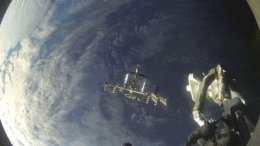
 1. Know that not all of humanity is bound to the ground
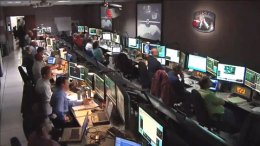
2. Smart people are up all night working in control rooms all over NASA to ensure that data keeps flowing from our satellites
Our satellites help scientists study Earth and space. Satellites looking toward Earth provide information about clouds, oceans, land and ice. They also measure gases in the atmosphere, such as ozone and carbon dioxide, and the amount of energy that Earth absorbs and emits. And satellites monitor wildfires, volcanoes and their smoke.
Satellites that face toward space have a variety of jobs. Some watch for dangerous rays coming from the sun. Others explore asteroids and comets, the history of stars, and the origin of planets. Some satellites fly near or orbit other planets. These spacecraft may look for evidence of water on Mars or capture close-up pictures of Saturn’s rings.
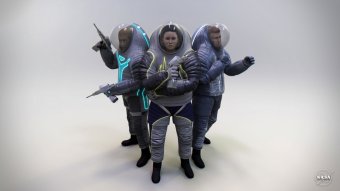
3. When we are ready to send humans to Mars, they’ll have the most high tech space suits ever made
Our Z-2 Spacesuit is the newest prototype in its next-generation platform, the Z-series. Each iteration of the Z-series will advance new technologies that one day will be used in a suit worn by the first humans to step foot on the red planet.
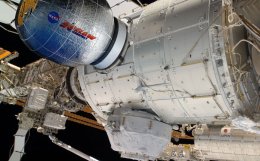
 4. When we need more space in space, it could be just like inflating a big high-tech balloon
The Bigelow Expandable Activity Module, or BEAM, leverages key innovations in lightweight and compact materials, departing from a traditional rigid metallic structure. Once attached to the International Space Station, the module would result in an additional 565 cubic feet of volume, which is about the size of a large family camping tent.
5. Even astronauts eat their VEGGIE’s
The Vegetable Production System (VEGGIE) is a deployable plant growth unit capable of producing salad-type crops in space. Earlier this year, Expedition 44 crew members, sampled the red romaine lettuce from the VEGGIE plant growth system. This technology will provide future pioneers with a sustainable food supplement during long-duration exploration missions.
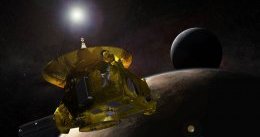
6. When you feel far away from home, you can think of the New Horizons spacecraft as it heads toward the Kuiper Belt…billions of miles away
 Our New Horizons spacecraft completed its Pluto flyby on July 14, and has continued on its way toward the Kuiper Belt. The spacecraft continues to send back important data as it travels toward deeper space at more than 32, 000 miles per hour, and is nearly 3.2 billion miles from Earth.
7. Earth has a magnetic field that largely protects it from the solar wind stripping away our atmosphere…unlike Mars
Recently announced findings from our MAVEN mission have identified the process that appears to have played a key role in the transition of the Martian climate from an early, warm and wet environment to the cold, arid planet Mars is today. MAVEN data have enabled researchers to determine the rate at which the Martian atmosphere currently is losing gas to space via stripping by the solar wind. Luckily, Earth has a magnetic field that largely protects it from this process.
8. Water bubbles look REALLY cool in space
Astronauts on the International Space Station dissolved an effervescent tablet in a floating ball of water, and captured images using a camera capable of recording four times the resolution of normal high-definition cameras. The higher resolution images and higher frame rate videos can reveal more information when used on science investigations, giving researchers a valuable new tool aboard the space station. This footage is one of the first of its kind.
 9. Americans will launch from U.S. soil again with the Commercial Crew Program
Our Commercial Crew Program is working with the American aerospace industry as companies develop and operate a new generation of spacecraft and launch systems capable of carrying crews to low-Earth orbit and the International Space Station.
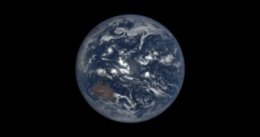
10. You can see a global image of your home planet…EVERY DAY
Once a day, we will post at least a dozen new color images of Earth acquired from 12 to 36 hours earlier. These images are taken by our EPIC camera from one million miles away on the Deep Space Climate Observatory (DSCOVR). Take a look HERE.
11. Starting on December 14, you can apply to be an astronaut
In anticipation of returning human spaceflight launches to American soil, and in preparation for our journey to Mars, we will soon begin accepting applications for the next class of astronaut candidates!
12. A lot of NASA-developed tech has been transferred for use to the public
Our Technology Transfer Program highlights technologies that were originally designed for our mission needs, but have since been introduced to the public market. HERE are a few spinoff technologies that you might not know about.
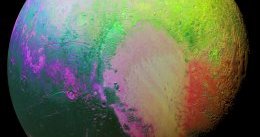
13. If all else fails, there’s this image of Psychedelic Pluto
This false color image of Pluto was created using a technique called principal component analysis. This effect highlights the many subtle color differences between Pluto’s distinct regions.

RELATED VIDEO


Share this Post
latest post
-
 Liu Yang (astronaut) October 19, 2026
 -
 Astronauts board October 13, 2026
 -
 Karen Nyberg, astronaut October 7, 2026
 -
 Gus astronaut October 1, 2026
 -
 Astronaut blog September 25, 2026
 -
 Amanda Palmer astronaut September 19, 2026
 -
 Astronaut helmet Child September 13, 2026
 -
 Astronaut Videos in Space September 7, 2026
 -
 Videos Of astronauts September 1, 2026